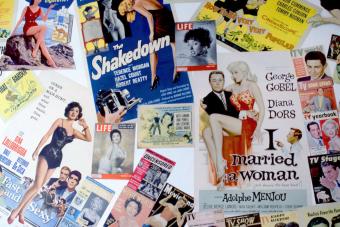
When you think of Woodstock, you may envision the multi-colored poster featuring a dove sitting atop an outstretched guitar's neck. This is the power that original vintage posters have even decades after they were first released. Whether you enjoy the ones relating to pop culture topics or gravitate towards antiquated imagery of theater venues and spirits, posters from this Golden Age feature such an array of designs that they're still highly collectible and beloved today.
Vintage Posters to Dazzle and Catch Your Eye
Posters as both a decorative and informative tool have been used for hundreds of years. Yet, it wasn't until Jules Cheret developed the three stone lithographic process in 1880 that posters turned into a new art form. Quickly after Cheret's three stone process was adopted, Ira Washington Rubel developed offset lithography, which helped with clarity and precision and became the main style of lithographic printing by the 1930s.
Of course, not all of the beautiful posters that you come across are considered lithographs, but the vast majority of posters by the 20th century were printed using lithographic methods. Despite using the same methods over the course of a few decades, posters from the late-19th century are far different from those created just 20 years later. It's thanks to this ever-evolving graphic design that collectors view posters created roughly between the 1880s-1960s to be the most valuable of those ever made.
That being said, vintage posters cover quite a range of topics, the most popular of which include:
- Travel
- Food and beverage
- Music
- Film
- Social activism
- Transportation
- Sports
- Propaganda
- Horror movies
Tips for Dating Vintage Posters From Just a Glance
Given the strong aesthetics and design characteristics of the major decades that artistic posters were being made in, it's actually pretty easy to approximately date a poster in your collection without an appraiser's help. Of course, if you want to get a concrete date, you'll need to contact an appraiser and set up an appointment.
When dating antique and vintage posters yourself, you can break down uniting characteristics by art movements and the corresponding decades that they occurred in.
Art Nouveau (1900s-1920s)
The Art Nouveau movement was well-known for its focus on fluidity, motifs and imagery from the natural world (insects, botanicals, and so on), as well as the use of uniquely bubbling typography. These posters were rich in colors, though softer in tone than in the following decades. Their muted and sinuous lines make them almost feel mythic in their construction. Artists that dominated this era were Henri Toulouse-Lautrec, Alphonse Mucha, and Theophile-Alexandre Steinlen, to name but a few.

Art Deco & Modernism (1920s-1940s)
When it comes to vintage posters, Art Deco & Modernist posters are by far the most popular, with Art Nouveau coming in at a close second. It was during the Art Deco movement that poster art really took on a new identity, one that reflected the bold geometry and use of interesting perspective into their designs. Solid blocks of saturated color were frequently featured alongside well-known simplistic, though elongated, typeface advertising things like transportation and travel. Notable poster artists from this period include A.M. Cassandre, Abram Games, Tom Eckersley, and FHK Henrion to name a few.

Retro & Mid-Century Modern (1950s-1960s)
Retro aesthetics were born out of post-war prosperity and the rise of consumerism, making posters largely become blatant advertising campaigns. Posters made during this period were filled with bright, vivid colors and playful displays. As the 1950s transitioned into the 1960s, pulp art and pop art started to make its way into poster designs, in the form of sultry, warm-colored scenes. Some of the major artists from the period include David Kelin, Rolf Armstrong, Stanley Walter Galli, and Reymond Brown, to name a few.

Ways to Authenticate Your Favorite Vintage Posters
Given how many reproductions there are on the market, it's really important to know the signs of a reproduction poster versus an original vintage poster. Here are a few of the 'tells' for what makes original posters distinctive.
- Color and ink vibrancy - Stone lithography techniques were replaced by offset and silkscreen printing in the post-war period, so especially for the interwar posters that're usually the most valuable, making sure your posters have a rich lasting hue is extremely important.
- Paper texture - Generally, modern prints are going to be glossier and lack substance, whereas the pulp used in the early 20th century is typically thicker and rougher.
- Pixelation - You won't find color pixelation when looking at early vintage posters with a close eye or magnifying glass since they weren't made with modern printing techniques.
How Much Do Vintage Posters Sell For?
Given that there are truly millions of posters out there from the Golden Age of Posters for sale, it's impossible to approximate how much posters from the period, or even specific decades, are currently worth. Similarly, physical condition, artists, and subject matter all play so heavily into what types of collectors or people want to purchase these prints that the variables make approximation impossible.
However, there are a few consistent characteristics that elevate some posters above others to be on the look out for. Firstly, there's always going to be a buyer for original posters from prominent artists like Alphonse Mucha and A.M. Cassandre, and they'll usually sell for hundreds or thousands of dollars depending on which print they are and their condition. Secondly, Art Deco and modernist posters are particularly in demand right now, meaning you'll see even unknown posters selling for a good amount. Lastly, poster size is a contributing factor for value; the larger the print can indicate greater values.
Here are just a few of the more valuable posters that've sold at auction to give you an idea of what exactly the Golden Age of Posters can sell for:

- 1929 Robert Bereny Modiano poster - Sold for $49,182.37
- 1928 A.M. Cassandre's L.M.S. Best Way travel poster - Sold for $162,500
- 1891 Henri Toulouse-Lautrec's Moulin Rouge poster - Sold for $412,450.71
- 1927 original international Metropolis film poster - Sold for $690,000
Take a Gander at the Past
Original vintage posters are fun collectibles that're perfect for both the serious collectors and the pop culture enthusiasts in your life. Covering nearly every design movement and subject possible in the first-half of the 20th century, these posters, which were once merely used for elaborate advertising campaigns in lieu of television commercials and targeted ads have become one of the most popular types of collectibles from the period today.


